What Is Greenwashing?
Greenwashing is when a product, company or service is marketed as better for the environment than it really is, usually through vague words, nature imagery or claims that can't be checked. The best defense is simple: look for claims that are specific, explain exactly what's better, and have evidence or a trustworthy certification behind them.
You'll run into greenwashing as soon as you start shopping more thoughtfully. This guide explains what the Federal Trade Commission says about environmental claims, the most common tricks, and a checklist you can use in any store aisle. It's part of the "how to tell what's real" thread in our Green Living Basics section.
What the FTC Green Guides say
The Federal Trade Commission (FTC) publishes the Green Guides, which explain how businesses should make environmental marketing claims so they don't mislead shoppers. A few key ideas from the FTC are worth knowing:
- Broad claims are a problem. The FTC says unqualified claims such as "eco-friendly" or "green" are hard to back up and are likely to mislead. A shopper might assume the product has no environmental downsides at all, which is almost never true.
- Claims should be specific. Instead of "green," a company should say what it means, such as which part of the product or package is better and in what way.
- Claims need evidence. A company should be able to support its environmental claims with evidence, not just a good feeling.
The Green Guides are guidance for businesses, not a product certification. A company can print a green-sounding claim on a box without anyone signing off on it first, so it pays to read claims carefully.
Common greenwashing tricks
| Trick | What it looks like | What to ask |
|---|---|---|
| Vague words | "Eco," "green," "natural," "earth-friendly" | Better in what way, exactly? |
| Nature imagery | Leaves, forests, planets, earthy colors | Is there an actual claim, or just a mood? |
| Hidden tradeoff | Highlighting one good feature while ignoring bigger issues | What about the rest of the product? |
| Irrelevant claims | Bragging about something every product already does | Is this different from competitors? |
| Unclear scope | "Made with recycled materials" | How much, and in the product or the package? |
| Made-up badges | A seal that looks official but isn't explained anywhere | Who runs it, and what are the requirements? |
| Lesser of two evils | Calling a product "greener" without saying compared to what | Greener than what, and by how much? |
None of these automatically means a product is bad. They mean the claim alone doesn't tell you much.
Specific claims versus vague claims
Here's how the same idea can be written two ways:
| Vague version | Specific version |
|---|---|
| "Eco-friendly packaging" | "Box made from recycled paperboard. Recyclable where cardboard is accepted." |
| "Natural cleaner" | "Full ingredient list on the back. Certified under a named third-party program." |
The specific versions tell you what to check. You can look up the certification, check your local recycling rules or read the ingredient list. The vague ones ask you to just trust the brand.
Words that deserve a second look
Some words show up on labels constantly. Here's how to read them:
- "Natural": Doesn't tell you how a product affects the environment or your health. Natural ingredients can still be harsh, and synthetic ones aren't automatically worse.
- "Biodegradable" and "compostable": These depend on conditions. Many compostable products are designed for industrial facilities, not backyard bins. For what those two words really mean, see biodegradable vs compostable.
- "Recyclable": The chasing-arrows symbol with a number identifies a plastic type, not whether your local program takes it. See what recycling numbers mean.
- "Carbon neutral": Ask how the company got there. Did it reduce its own emissions, or pay for offsets elsewhere? Specific details are a good sign. If you want to understand the underlying idea, our carbon footprint basics guide explains it in plain words.
- "Non-toxic" and "chemical-free": Everything is made of chemicals, and these phrases aren't standardized. Read the ingredient list and safety directions instead.
A five-step checklist for any claim
- Find the actual claim. Ignore the colors and pictures. What words make a promise?
- Ask "better how?" A real claim names a specific benefit, such as recycled content, lower water use or a certified ingredient review.
- Look for a third party. A label from an independent or government program, with published requirements, carries more weight than a brand's own badge. Our eco labels explained guide covers the ones worth knowing.
- Check the scope. Does the claim apply to the product, the package or just one part?
- Ask if you need it. The greenest product is often the one you don't buy, or the one you already own.
Example: two dish soaps
This is a fictional example.
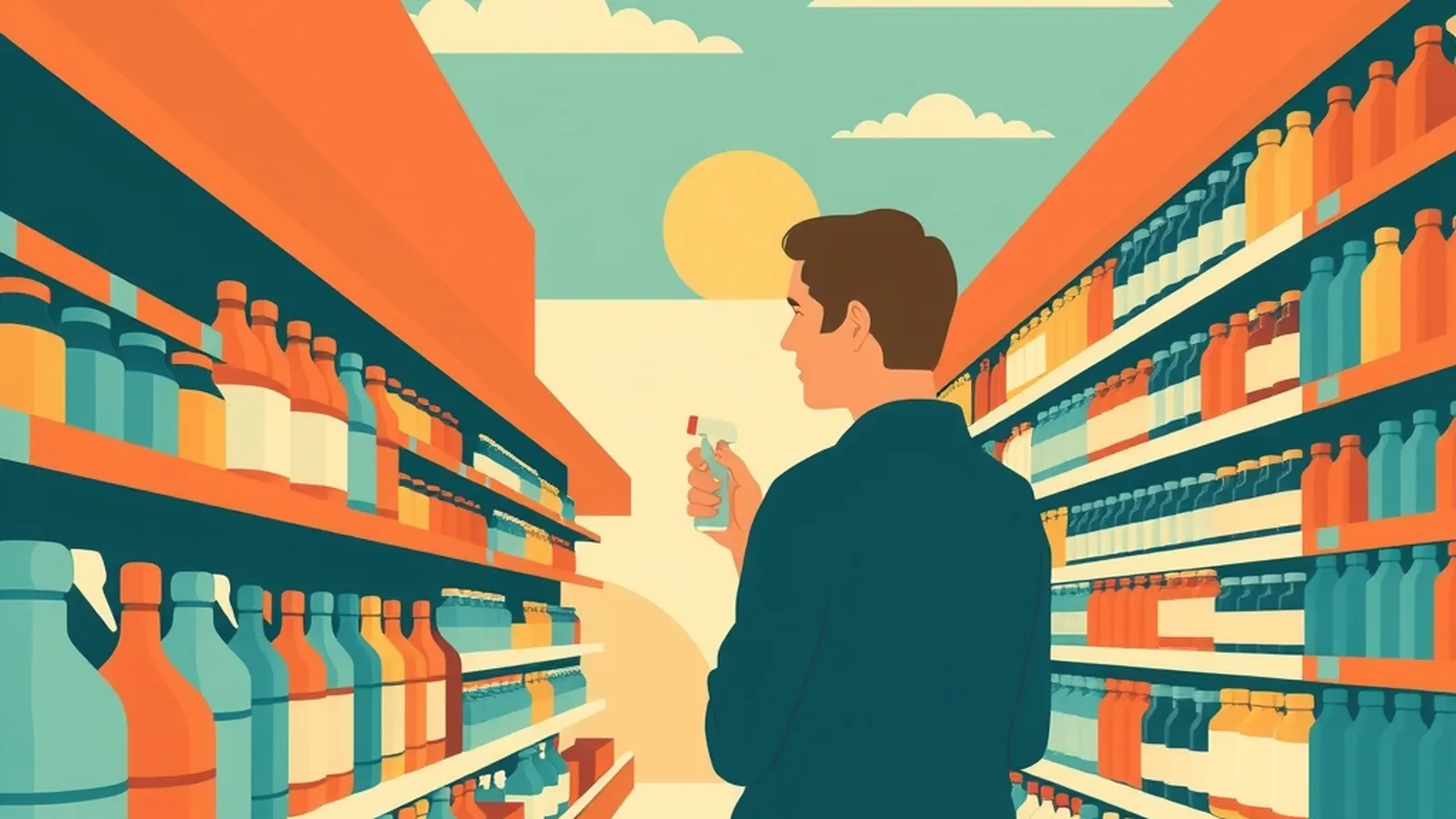
Alex is choosing between two bottles of dish soap. One is covered in leaves and says "pure and natural." The other is plain but lists its ingredients and carries a government safety label with published criteria. Alex picks the second one because it gives information they can check. They also decide to finish the bottle under the sink first.
Greenwashing beyond products
Greenwashing isn't limited to the grocery store. You might see it in:
- Energy-saving gadgets that promise big savings with no clear explanation of how they work.
- Solar pitches that call panels "free" or claim a government connection.
- Paid green-living courses that promise you'll never pay a utility bill again.
When the promise sounds too good, slow down. Our guide to green product red flags covers the warning signs for scams and overblown devices.
Don't let it stop you
Greenwashing can make you cynical about every eco claim. Try not to let it. Many companies make honest, specific claims, and many useful switches don't involve buying anything at all. Our list of easy sustainable swaps starts with using what you have. When you do shop, our guide to choosing eco-friendly products walks through five questions to ask before buying.
Something to do this weekend
Pick three products in your home, such as a cleaner, a snack package and a personal care item. Read each label and sort the claims into "specific and checkable" or "vague." Look up any certification you find. You'll start spotting the difference on autopilot.
Want a step-by-step plan or guide?
Some people like the structure of a paid guide or set of plans. This button opens a third-party program from one of our advertising partners. Its claims are its own, not ours, so weigh them against our checklist for judging paid plans.
See the partner program →We may be paid when you click. The program shown can change. Read its terms before you buy anything. How this works
Frequently asked questions
What is an example of greenwashing?
A bottle of cleaner labeled "eco-friendly" with green leaves on it, but no explanation of what makes it better, is a common example. The claim sounds good but doesn't tell you anything you can check.
What are the FTC Green Guides?
They're guidance from the Federal Trade Commission on how businesses should make environmental marketing claims. The FTC says broad claims like "green" or "eco-friendly" are hard to back up and likely to mislead, so claims should be specific and supported by evidence.
Is greenwashing illegal?
Deceptive advertising can break federal and state consumer protection laws, and the FTC uses its Green Guides to explain how environmental claims should be made. Whether a specific claim crosses the line is a legal question, so this is general information, not legal advice.